
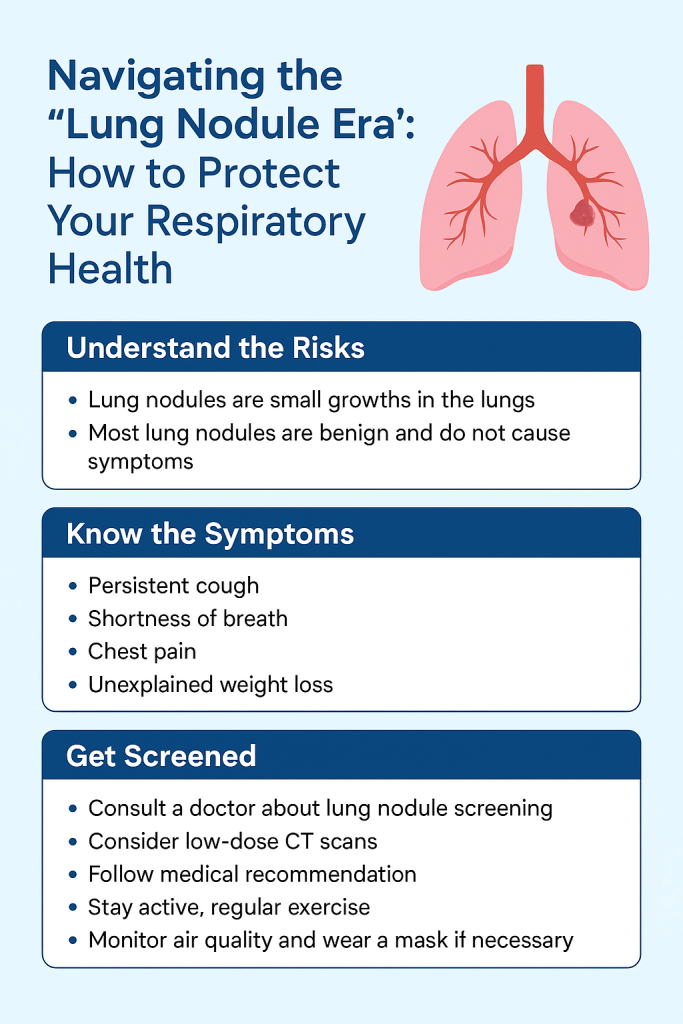
Recent data paints a startling picture: lung nodule detection rates are skyrocketing. In China alone, there are an estimated 150 million high-risk individuals, with 10 to 20 million new cases identified annually. A 2021 screening study by Beijing Xuanwu Hospital revealed a detection rate of nearly 58.9%, with 25.1% identified as “ground-glass opacities.”
As detection rates rise globally, a common question arises: Why are lung nodules suddenly so common, and how do we protect our breath?
Why Are We Seeing More Lung Nodules?
The surge in diagnoses isn’t necessarily because our lungs are suddenly failing; it is largely due to two key factors:
Advanced Detection Technology: Modern CT scans are incredibly sensitive. Small nodules that previously went unnoticed are now easily detected.
Post-Pandemic Screening: During the COVID-19 era, many individuals underwent chest CT scans for fever, cough, or chest tightness, inadvertently revealing pre-existing nodules.It is important to note that 30%–40% of healthy adults have lung nodules. The vast majority are benign and simply require periodic monitoring.
What Exactly is a Lung Nodule?
A lung nodule is defined as a round or oval spot (shadow) on the lung that is smaller than 3 centimeters in diameter. (Anything larger is typically classified as a mass).
Think of your lungs as the body’s largest “air purifier.” Every day, you take approximately 20,000 breaths. Your alveoli (air sacs) exchange gases in just 0.3 seconds while immune cells on the surface fight off pathogens.
When you inhale pollutants—like PM2.5, cooking fumes, or cigarette smoke—your lungs initiate an “inflammation control” mode. While this is a normal immune response, chronic irritation can cause immune cells to overreact, forming the small white spots (nodules) seen on CT scans.
The 6 Main Culprits: Where Do Nodules Come From?
Smoking: Tobacco contains nearly 100 carcinogens that directly damage lung tissue.
Air Pollution: PM2.5 and ultrafine particles can bypass nasal defenses, reaching the alveoli and entering the bloodstream, causing chronic inflammation.
Occupational Exposure: Jobs in mining, construction, textiles, or chemical industries often involve inhaling dust loads that exceed the lung’s self-cleaning capacity.
Cooking Fumes: Long-term inhalation of oil smoke (which contains benzo[a]pyrene) is a significant risk factor, particularly in home kitchens.
Biological Infections: Viruses (Flu, COVID-19) or bacteria can leave behind inflammatory scars or “immune debris.”
Internal Imbalance: A weakened immune system reduces the lung’s ability to clear foreign matter and repair damage.
Risk Assessment: Which Nodules Require Action?
While most nodules are harmless, complacency is dangerous. You must pay close attention if your nodule presents the following characteristics:
High-Risk Morphology: Nodules larger than 8mm with unclear boundaries, lobulated shapes, spiky edges (spiculation), or internal vacuoles/vessels.
Growth Trend: Even small nodules are concerning if they show continuous growth upon re-examination.
Mixed Ground-Glass Nodules: Nodules that are partially solid and partially “ground-glass” (hazy) have a malignancy rate exceeding 60% and require strict medical attention.
BISPIT: The Science of Lung Preservation
Even benign nodules require care to prevent progression. Enter BISPIT, a breakthrough lung health solution designed for the modern environment.
BISPIT is the first herbal lung care product to receive a US National Drug Code (NDC), marking a milestone in integrative respiratory health.
The Formulation
BISPIT bridges ancient wisdom with modern pharmacology. It draws from the Compendium of Materia Medica to “clear the lungs, dissolve phlegm, and disperse knots,” while utilizing advanced extraction tech.
Core Ingredients: Sophora Japonica extract (Quercetin), EGCG (Green Tea extract), Astragalus, Fritillaria (Zhebei), and Platycodon (Balloon Flower root).
Mechanism of Action:
Astragalus: Strengthens the body’s defensive energy (Qi).
Fritillaria & Platycodon: Target and expel pathogens/phlegm.
Sophora & EGCG: Clear the source of inflammation.
This synergistic approach aims to double the effect: enhancing lung immunity while dissipating nodal accumulation. The product utilizes low-temperature supercritical extraction to ensure the biological activity of these ingredients remains intact.
Who is BISPIT For?
Individuals with chronic pharyngitis or frequent coughs.
Long-term smokers and those exposed to second-hand smoke.
Teachers (chalk dust exposure) and Chefs (oil fume exposure).
Anyone looking to proactively prevent lung nodules and improve respiratory clarity.
Conclusion
Facing the challenge of lung health in a polluted world can be daunting, but anxiety is unnecessary. With scientific awareness, regular screening, and the right intervention—like BISPIT—we can protect our breath.
Guard your lungs today for a smoother, safer breathe tomorrow.